
Reviewed · WALKING TOURS
The Dublin Private Walking Tour
Dublin reveals itself best on foot, and this private tour gives you a lively sweep from Temple Bar to Merrion Square in about three hours. You’ll hear Irish music stories, see Trinity College and Georgian Dublin, cross the Ha’penny Bridge, and get a quick grounding in Ireland’s politics and past.
I like the private format, since Pasquale, Conor, Sharon, or Seamus can adjust the pace and spend more time on what interests you. I also like the range of stops: this is not just a pub-and-photo walk, but a route that links music, literature, famine memory, government, shopping streets, and everyday Dublin.
The main drawback is the amount of ground covered. Fourteen stops in three hours means the tour is an overview, not a deep visit inside major attractions. Admission is not included because the route is built around outdoor sights, so plan separate visits to places you want to explore at length.
Key points to know before booking
- Fourteen central Dublin stops: The route runs from Claddagh Records and Temple Bar to Trinity College, St. Stephen’s Green, Leinster House, and Oscar Wilde’s monument.
- A genuinely private experience: Only your group takes part, making it easier to ask questions, slow down, or shift the focus.
- Guides with different strengths: Pasquale is praised for humor and Irish history, Conor for local stories, music, Irish language, photos, and a memorable video, while Sharon and Seamus also lead tours.
- Mostly outdoor sightseeing: Admission is free at every listed stop, but the tour does not replace a paid visit inside Trinity’s Book of Kells or other attractions.
- Useful on your first Dublin day: The route helps you understand the city center and gives practical advice on pubs, restaurants, shops, and places to return to.
- Prepare for Irish weather: Good walking shoes and a light rain jacket are wise. Umbrellas are provided, and rest or toilet breaks can be arranged if needed.
Starting in Temple Bar with music and local character
The tour begins at Travelling Ireland on Cecilia Street in Temple Bar, a handy central location. Starting here puts you in the middle of Dublin’s most famous visitor district, but the first stops add more substance than a quick look at its colorful pubs.
At Claddagh Records, your guide introduces Ireland through music and the famous Claddagh ring. The stop is brief, about ten minutes, but it sets the tone. Irish culture is not treated as a list of old symbols. You begin with music, craft, identity, and the everyday ways Ireland presents itself.
The nearby Wall of Fame celebrates Irish performers including U2, Phil Lynott, Van Morrison, Sinéad O’Connor, and The Cranberries. Music fans will enjoy this most, but even if you are not making a special pilgrimage to Dublin’s music sites, it gives you a quick sense of how strongly popular culture is tied to the country’s public identity.
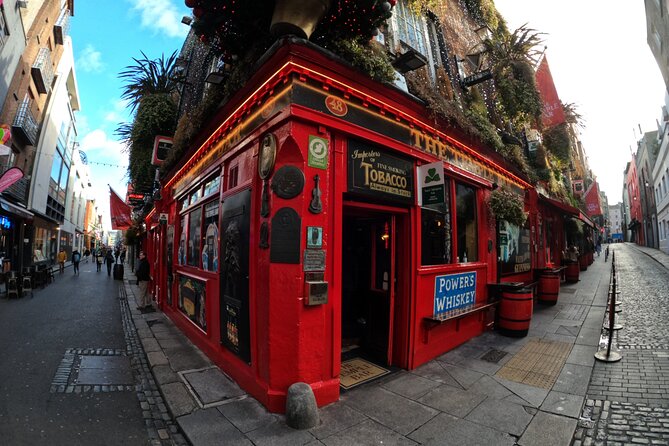
You then move through the Temple Bar area and learn about the Temple Bar Pub, established in 1840. The cobblestones and old facades are photogenic, but this is also the part of Dublin that can feel most geared to visitors. I would treat it as an orientation stop rather than a recommendation to spend your whole evening here. Your guide’s pub and restaurant suggestions can help you make better choices later.
More Walking Tours in Dublin
- Dublin Highlights and Hidden Gems Guided Walking Tour
★ 5.0 · 6,020 reviews - Dublin: Highlights and Hidden Gems Walking Tour
★ 4.9 · 2,140 reviews - 1916 Rebellion Walking Tour
★ 5.0 · 1,605 reviews
Crossing the Liffey at the Ha’penny Bridge
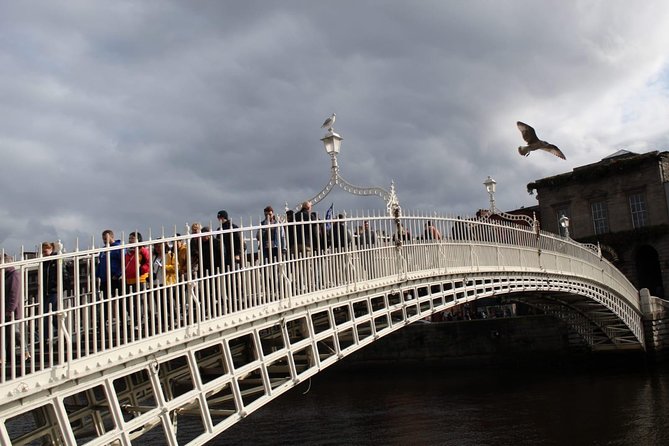
The walk continues to the Ha’penny Bridge, one of Dublin’s most recognizable views. Your guide explains the bridge’s past and uses the River Liffey to discuss Dublin’s social and economic divisions.
That context matters. A bridge is easy to photograph and forget, but the Liffey has long been a useful way to understand the city’s two sides, its neighborhoods, commerce, and changing identity. This is one of the tour’s better examples of a simple sight becoming more useful once you know what to notice.
The stop lasts about fifteen minutes. Expect pedestrians, traffic, and limited room for a long talk, especially at busy times. The private setup helps here because your guide can keep the group together without managing a large crowd.
College Green, Parliament, and Trinity College
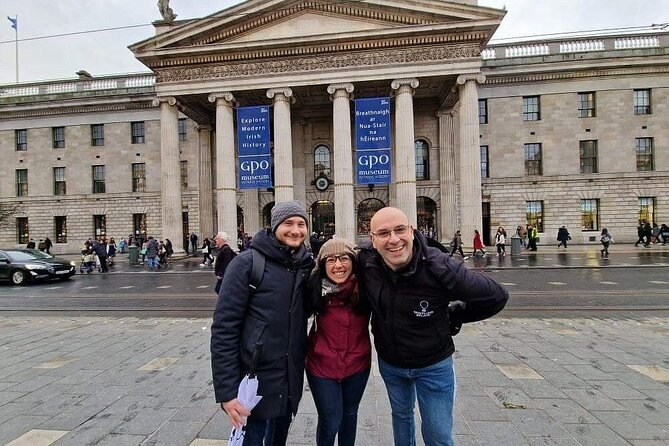
College Green gives you several important sights in one compact urban space. The Bank of Ireland building occupies the former Irish Parliament House, while Trinity College faces the plaza and nineteenth-century buildings line the southern side.
This is a valuable history lesson because the buildings are not isolated attractions. You see how politics, education, commerce, and architecture meet in central Dublin. The former Parliament House also gives your guide a natural opening to explain Ireland’s constitutional past.
At Trinity College, you stroll through the campus and hear about Ireland’s oldest college, along with its place in present-day Dublin. The campus is a highlight for first-time visitors, but the fifteen-minute stop has limits. You will get orientation and outdoor context, not a full college tour or a visit to the Book of Kells.
That distinction is important when judging the $163.26 per-person price. The tour covers a great deal, but it does not include paid admissions. You should see it as a guided introduction that helps you decide where to return, not as a substitute for every major Dublin attraction.
Molly Malone and the energy of Grafton Street
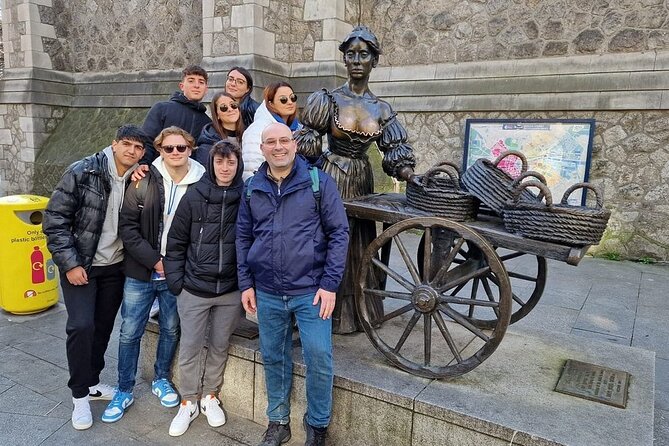
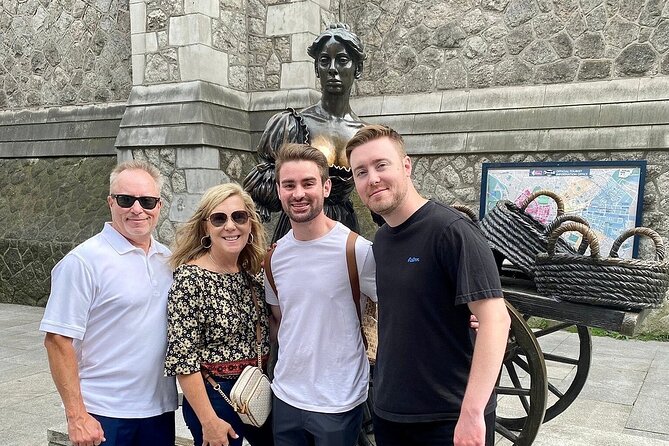
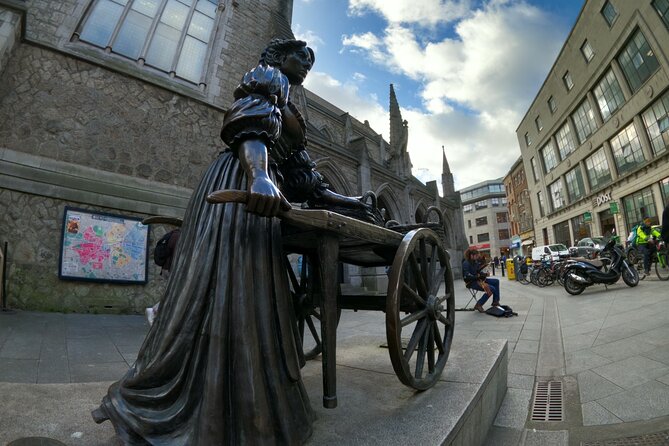
The Molly Malone statue provides a compact lesson in Dublin folklore and the famous song associated with her. Nearby St. Andrew’s Church adds another historic reference point.
Molly Malone is a good stop for families because it is quick, visual, and easy to connect with local culture. It also gives your guide room to explain how folklore, songs, and public monuments shape the way a city tells its own story.
From there, the route follows Grafton Street, one of Dublin’s best-known shopping streets. Brown Thomas represents the polished, luxury side of the street, while musicians, poets, and other performers give it a more informal feel. The contrast is part of the appeal.
You should not expect a quiet stroll here. Grafton Street is busy and commercial, and the pace may slow around performers or crowds. Still, it is a useful place to see modern Dublin rather than only historic buildings.
Same part of the country, a completely different day out:
- Dublin: Guinness Storehouse Entry Ticket
★ 4.6 · 16,863 reviews - Irish Rock ‘N’ Roll Museum Experience Dublin
★ 5.0 · 6,112 reviews - Dublin: Jameson Whiskey Distillery Tour with Tastings
★ 4.7 · 4,859 reviews - Dublin Jameson Distillery Bow St. Tour and Tasting 45 mins
★ 5.0 · 4,690 reviews
A pause in St. Stephen’s Green
St. Stephen’s Green offers a change of pace. The route takes you into Dublin’s central park, where swans, ducks, and other wildlife soften the city center.
This is a smart inclusion in a three-hour walking route. You get a chance to breathe, take photographs, and sit briefly if needed. Families may especially appreciate the open space, and the park makes a good place for your guide to adjust the pace.
The stop is listed at about fifteen minutes, so do not expect a long park visit. You will see the setting and get a feel for it, then continue. If you want a detailed look at the park, return later with more time.
Famine memory and the politics of modern Ireland
The Edward Delaney Famine Memorial brings a more serious mood to the walk. Its thin, struggling figures represent the hunger and hardship endured during the Great Famine.
This stop gives the tour emotional weight. Dublin sightseeing can easily become a string of attractive streets and famous names, but the memorial asks you to think about suffering, displacement, and the lasting effect of famine on Irish society. Your guide can provide the historical setting that a quick photograph cannot.
The nearby statue of Theobald Wolfe Tone introduces another major chapter. Tone is widely regarded as the father of Irish republicanism, and the statue sits in front of the Shelbourne Hotel. The pairing of the memorial and statue helps connect social hardship with political change.
These are short stops, around ten to fifteen minutes each. If Irish political history is your main interest, tell your guide at the start. The private format gives you the best chance of getting more explanation, though the overall route still has many places to cover.
Georgian Dublin, government, and Leinster House
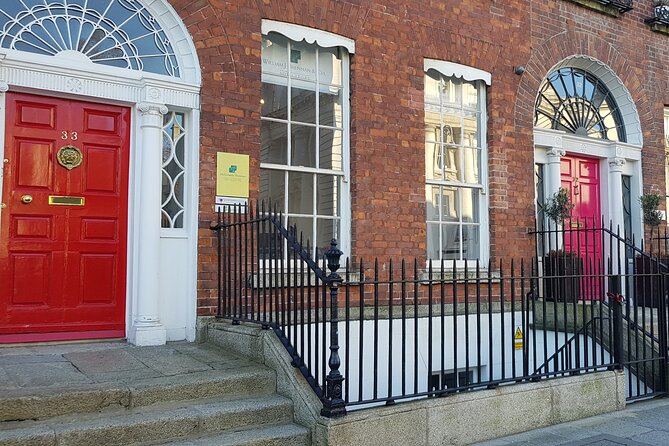
The Department of the Taoiseach takes you into Dublin’s Georgian district. You will look at the architecture and learn about the government department connected to Ireland’s prime minister.
This part of the walk is less instantly famous than Temple Bar or Trinity College, but it rewards attention. Georgian streets can appear uniform at first glance. A guide can point out how the buildings, squares, official offices, and former residences fit together.
Leinster House continues the political theme. It was once the ducal residence of the Duke of Leinster and has served as the parliament building of the Irish Free State since 1922. The building is a useful link between aristocratic Dublin, the Irish state, and the political center you see today.
Again, you will view the site from outside. This is a good route for understanding Dublin’s civic story, but not for anyone expecting access to government interiors.
Finishing with Oscar Wilde in Merrion Square
The final stop is the Oscar Wilde Monument in Merrion Square Park. You will see the memorial and Wilde’s eighteenth-century home, while your guide explains the park as an example of Georgian urban design.
Ending here is logical. The route moves from music and pubs through bridges, college buildings, folklore, parks, famine memory, politics, and literature, finishing in one of Dublin’s most handsome residential areas.
Merrion Square also has a quieter feel than Temple Bar and Grafton Street. It is a pleasant place to finish, and the location gives you a choice: continue exploring the Georgian area, return toward the city center, or use the guide’s restaurant suggestions for your next meal.
The official end point is the Oscar Wilde Monument on Merrion Square North. Since the start and finish are different, think of this as a one-way introduction rather than a loop back to Temple Bar.
What the private guiding adds
The strongest feature is the personal attention. Pasquale is repeatedly praised for warmth, humor, Irish history, and a relaxed pace. Conor brings a different mix, with local Dublin experience, Irish language, singing and dancing, photo stops, and a commemorative video with music and mapped locations.
Sharon has also led the tour, adding historical detail and discussion of current Irish politics. Seamus is described as friendly, respectful, and good at shaping the walk around specific interests. The guide you receive may vary, so you should not book on the assumption that one named guide is guaranteed unless the operator confirms it.
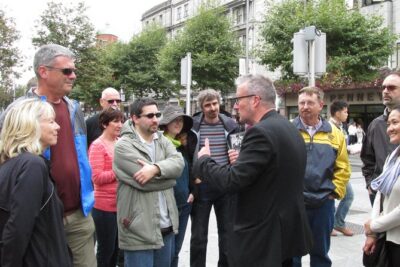
The private format is especially useful for families, first-time visitors, and people who dislike large groups. You can ask why a statue matters, stop for photos, discuss music, or request food advice without holding up a busload of people. Rest and toilet breaks are available if needed, and all age groups are catered for.
The tradeoff is price. At $163.26 per person, this is not a budget city walk, especially for a larger family. Group discounts may improve the value, and the price makes more sense when your group uses the guide well: ask questions, request local recommendations, and make the walk your first major Dublin activity.
Timing, walking, and weather
The tour lasts about three hours and offers a range of departure times. That flexibility helps you place it on your first day, when the main goal is to get your bearings, or later if you want a final look at central Dublin.
You will walk between fourteen stops, with each stop lasting roughly ten to fifteen minutes. Good walking shoes are essential. A light rain jacket is sensible even when the forecast looks kind, while umbrellas are provided.
Most people can take part, and service animals are allowed. The route is near public transportation, but the supplied details do not promise a fully step-free route or specify the walking distance. If mobility is a concern, ask the provider before booking and explain what your group needs.
Who will get the most from this Dublin walk
I would choose this tour for a first visit, especially if you want history and local orientation without committing to long indoor visits. It also suits repeat visitors who want a private guide to connect familiar sights with Irish music, politics, folklore, and current life.
Families can benefit from the short stops and outdoor format, though very young children may find three hours tiring. One family chose a longer version and found that the guide worked hard to keep children engaged, but the route still involved a substantial amount of walking.
Music fans should pay attention to Claddagh Records and the Wall of Fame. History fans will get more from the famine memorial, Wolfe Tone, Leinster House, and Georgian Dublin. Food and pub seekers should use the guide’s recommendations as a starting point rather than assuming Temple Bar is the only answer.
Should you book the Dublin Private Walking Tour?
Book it if you want a friendly, adaptable introduction to central Dublin and value having a guide for your own group. The route covers a lot, the guides bring humor and personal stories, and the practical tips can save you time during the rest of your stay.
Skip it if you want extended interior visits, a slow architectural study, or the lowest possible price. You will see many important places from outside and may need separate tickets and return visits.
For the best value, schedule it near the start of your Dublin stay, tell the guide what interests you, wear comfortable shoes, and leave room afterward for Trinity College, a museum, or another site that catches your attention. Free cancellation is available up to 24 hours before the start time, which gives you some useful flexibility.
FAQ
How long is the Dublin Private Walking Tour?
The tour lasts approximately three hours.
Where does the tour begin and end?
It begins at Travelling Ireland, 8 Cecilia Street in Temple Bar, Dublin. It ends at the Oscar Wilde Monument on Merrion Square North.
Is this a private tour?
Yes. Only your group participates, so the guide can adjust the pace and focus to your interests.
Is admission to the attractions included?
The listed stops have free admission, and the tour is mainly an outdoor walking experience. It does not include separate paid admissions to attractions.
Who can participate in the tour?
All age groups are catered for, and most people can participate. Service animals are allowed, and rest or toilet breaks can be arranged if needed.
What happens if I need to cancel?
You can receive a full refund if you cancel at least 24 hours before the experience begins. Cancellations or changes made less than 24 hours before the start time are not accepted for a refund.
Just added around Dublin
- Turtle Bunbury’s Dublin: A Self-Guided Audio Tour from a Celebrated Author★ 5.0 · 3 reviews
- Trek the Tombs and Trails in the Dublin Mountains★ 5.0 · 14 reviews
- Private Tour of Dublin Museums (Walking Tour)★ 5.0 · 13 reviews
- Taste traditional Irish food in the heart of Dublin★ 5.0 · 24 reviews
- Dublin 6 Whiskey Tasting & 3 Food Pairing Walking Tour with Local★ 5.0 · 42 reviews
- Small Group Bucket List Sights Walking Tour with a Local Guide★ 5.0 · 54 reviews
- From Dublin: Private Tour to Hill of Tara, Trim Castle and more★ 5.0 · 11 reviews
- Merry Ploughboys Irish Night Dublin Admission Ticket★ 4.5 · 59 reviews
Walking Tours, compared.
Dublin Highlights and Hidden Gems Guided Walking Tour
Our verdict on it →

90 Minute Dublin Walking tour and Sightseeing tips
Our verdict on it →

Dublin Traditional Irish 3 Course Meal Walking Tour with Local
Our verdict on it →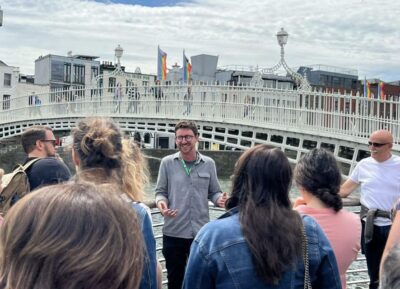
Browse the lists this tour appears in