
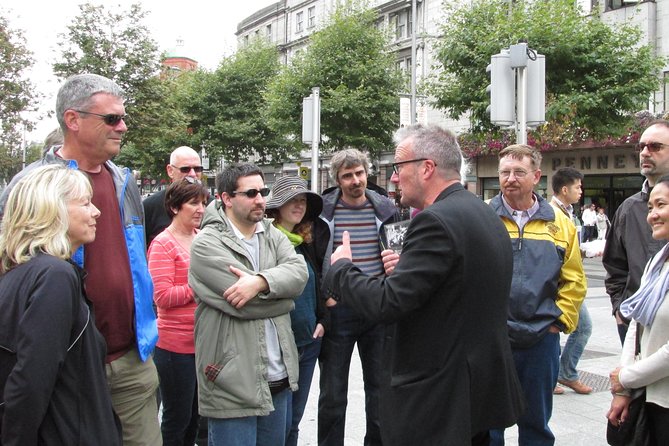
Reviewed · WALKING TOURS
1916 Rebellion Walking Tour
Dublin’s 1916 Rebellion Walking Tour puts you on the streets where the Easter Rising unfolded. The most powerful stop is the GPO, where Pádraig Pearse read the Proclamation, but the tour gains force by linking that famous building with bullet-scarred monuments, government offices, statues, bridges, and the old center of British rule.
I like the clear opening lesson, which begins with the Great Hunger and builds toward 1916 instead of dropping you into a maze of names. I also like the human storytelling, including rebel songs, personal stories, and time for questions. The main thing to consider is pace: the advertised two hours can run closer to three, especially with a large group of up to 30 people.
Key points to know before booking
- Starts at the International Bar: Arrive early if you want a drink and time to read the introductory material.
- Covers more than Easter Week: The route connects the 1916 Rising with the Great Hunger, the War of Independence, and the 1922 Civil War.
- The GPO gets the longest stop: Expect about 30 minutes at the central building of the rebellion.
- Guides bring different strengths: Lorcan Collins is associated with the tour, while guides including Liz, Phelim, Donal, Phil, Fallon, Adam, and Elaina have also led walks.
- Mostly outdoor history: You see sites up close, but much of the teaching happens on streets, bridges, and pavements.
- Good value for serious history fans: At about $27.81, the price is fair if you want context rather than a quick sightseeing loop.
Why the 1916 Rising makes sense on foot

The Easter Rising can feel confusing when you first encounter it. There are many people, political groups, buildings, dates, and later conflicts to keep straight. This tour handles that problem by placing the story on a walkable Dublin route.
The opening lesson starts at the International Bar on Wicklow Street. The guide first explains the Great Hunger of the 1840s and the political pressure that followed. From there, the story moves toward the revolutionary period and the 1916 Rising. That order matters. You begin to see why independence was not a sudden idea invented in 1916.
I especially like this approach for anyone who knows the broad outline but not the details. You do not need to arrive with a stack of books under your arm. At the same time, the material is substantial enough for people who already know the names of Pearse, Connolly, Larkin, and Collins.
The tone is serious, but it is not a dry lecture. Guides have used poetry, songs, humor, and short stories to give the political events a human face. That variety helps during a long stretch of walking and makes the different stops easier to remember.
More Walking Tours in Dublin
- Dublin Highlights and Hidden Gems Guided Walking Tour
★ 5.0 · 6,020 reviews - Dublin: Highlights and Hidden Gems Walking Tour
★ 4.9 · 2,140 reviews - 90 Minute Dublin Walking tour and Sightseeing tips
★ 5.0 · 916 reviews
Beginning at the International Bar on Wicklow Street
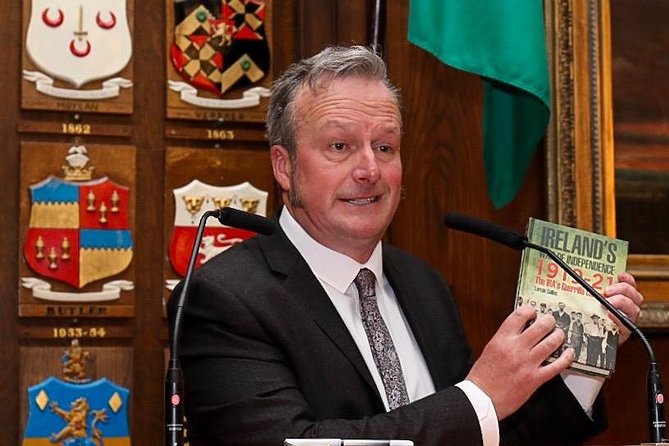
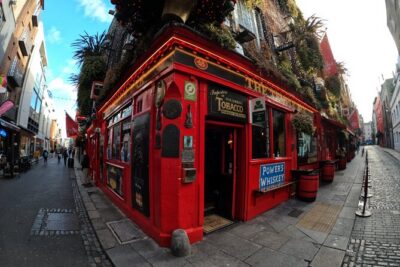
The meeting point is the famous International Bar at 23 Wicklow Street. The tour has been associated with guide Lorcan Collins since 1996, and the bar is more than a place to gather. It sets the mood for a walk about politics, rebellion, and Dublin’s literary and pub culture.
You can arrive early for a drink, but that purchase is not included in the tour price. Introductory reading is supplied, so arriving ahead of time can help you get your bearings before the guide begins.
The first talk lasts about 15 minutes. It gives the group a shared starting point and allows questions before the route begins. I consider this one of the most useful parts of the experience because it prevents the rest of the walk from becoming a string of disconnected landmarks.
The route can vary from day to day. That keeps the tour from becoming a rigid performance, but it also means you should not treat every listed stop as guaranteed in exactly the same order. The main sites are part of the typical route, with some choices depending on time and the guide.
City Hall and Dublin Castle: power in two nearby places
At City Hall, the guide explains the role of the Irish Citizen Army during the 1916 Rising. This stop helps show that the rebellion involved more than one group and more than one political vision.
The Irish Citizen Army had strong links to Dublin’s working class and to James Connolly. That story connects naturally with the later stop at the Jim Larkin statue. You begin to see the Rising not only as a national struggle, but also as part of a fight over workers, poverty, and social change.
The walk then continues to Dublin Castle, the center of British administration in Ireland. The building gives you a physical sense of the authority that the rebels were challenging. The guide discusses its part in the 1916 Rising and the War of Independence, with the site familiar to some visitors from the film about Michael Collins.
These two stops work well together. City Hall represents one occupied position during the Rising, while Dublin Castle represents the administration the revolutionaries sought to replace. You are not simply looking at attractive old buildings. You are being shown how control of Dublin was organized and contested.
The Four Courts and the path toward civil war
The Four Courts adds a later chapter to the story. Revolutionaries occupied it during the 1916 Rising, and it became important again during the events leading to the Irish Civil War in 1922.
The building is usually viewed from a bridge over the River Liffey rather than approached directly. That viewpoint is practical, since it gives the group a better sense of the building and its position. Still, this is one stop where you should expect the surroundings and group size to affect how well you hear.
The guide uses the Four Courts to explain the difficult break between those who accepted the Anglo-Irish Treaty and those who rejected it. This is valuable because the 1916 story did not end when the rebellion was defeated. Political divisions continued, and some of the people who had fought against British rule later fought one another.
That extra context sets this tour apart from a simple Easter Week walk. You get a route through the events of 1916, but also a short explanation of how those events fed into the War of Independence and Civil War.
Same part of the country, a completely different day out:
- Dublin: Guinness Storehouse Entry Ticket
★ 4.6 · 16,863 reviews - Irish Rock ‘N’ Roll Museum Experience Dublin
★ 5.0 · 6,112 reviews - Dublin: Jameson Whiskey Distillery Tour with Tastings
★ 4.7 · 4,859 reviews - Dublin Jameson Distillery Bow St. Tour and Tasting 45 mins
★ 5.0 · 4,690 reviews
Bullet holes, statues, and the human scale of rebellion
At the O’Connell Monument, the guide points out bullet holes left by the fighting. Details like this can change the way you see Dublin. Instead of treating the Rising as a distant political event, you notice the physical marks that remain on the city.
The monument also helps the guide explain the positions held by British forces and Irish rebels in 1916. A statue becomes a map, a witness, and a clue to the street fighting around it.
The Jim Larkin statue adds another human angle. Larkin, a union organizer from Liverpool, was a close ally of James Connolly and an important figure in Dublin’s working-class movement. The stop gives the guide a chance to explain his contribution to the revolutionary period and to connect labor politics with the wider independence movement.
I like these smaller stops because they break up the major buildings. The GPO is essential, but statues and street details help you understand the people behind the speeches and military plans. Guides have also addressed the role of women in Irish social and political history, which is useful if you want more than a list of male leaders.
The GPO, where the story reaches its center
The General Post Office is the emotional center of the walk. It served as headquarters for the revolutionaries in Dublin, and it was where Pádraig Pearse read the Proclamation of the Irish Republic.
The stop can last about 30 minutes, longer than most others. That extra time is needed. The guide explains the opening of the Rising, the occupation of the building, the meaning of the Proclamation, and the final stages of the GPO garrison.
You should expect this to be a standing outdoor talk rather than a museum visit. The tour does not include admission to an indoor exhibition, and the focus is on the building, the street, and the events that took place there.
The GPO is important to Irish national identity, but the guide’s job is not only to praise it. The strongest part of the discussion is the mixture of idealism, military confusion, destruction, and loss. Guides have used songs and poetry here, which can make the stop feel more personal without replacing the factual explanation.
If you have limited time in Dublin, this is the one place on the route you should make sure you understand. It ties together the earlier discussion of British rule, labor politics, rebel planning, and the meaning of public declarations.
Moore Street and the last stand of the GPO garrison
Depending on the route and the time available, the group may continue to Moore Street. This is where the GPO garrison made its last stand during Easter Week.
The Moore Street stop gives the story a final street-level scene. After the GPO was damaged and no longer defensible, the rebels moved through the surrounding area. The guide explains how the final phase unfolded and why Moore Street remains important in the memory of the Rising.
Because this stop depends on the route, I would not book the walk solely for Moore Street. Think of it as an added piece that may complete the GPO story. The route varies, and a large group or a longer discussion at an earlier stop can affect what fits into the two-hour plan.
The Old Parliament and Trinity College area
The Bank of Ireland is also known as the Old Parliament. If the guide includes this section, you will hear about its role in Irish political history and its neighbor, Trinity College.
This stop broadens the story beyond the rebellion itself. Dublin’s political history was shaped by institutions, education, administration, and public debate long before Easter Week. Seeing the Old Parliament near Trinity College gives the guide a chance to place the 1916 movement within that longer setting.
Again, the exact route is not fixed. That flexibility can be a plus for repeat visitors, but first-time visitors should understand that the tour is not a guaranteed checklist of every site. The central story remains the same, while the path can change.
Guides, storytelling, and group size
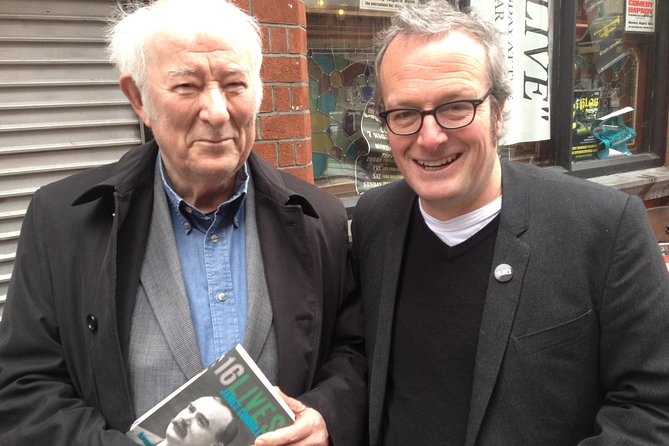
The guide makes or breaks a history walk, and this experience has a strong record in that area. Lorcan Collins is the best-known name connected with the tour, but other guides include Liz, Phelim, Donal, Phil, Fallon, Adam, and Elaina.
Their styles differ. Phelim and Phil have used songs and poetry. Liz has been praised for fitting a large amount of material into a short time. Elaina has placed special attention on women’s roles and social history. Donal and Lorcan are associated with a passionate, personal delivery, while other guides bring humor and a lively performance style.
That variation is worth knowing before you book. You are signing up for a shared tour format, not a guaranteed individual guide. The common thread is a strong command of the subject, clear speaking, and time for questions.
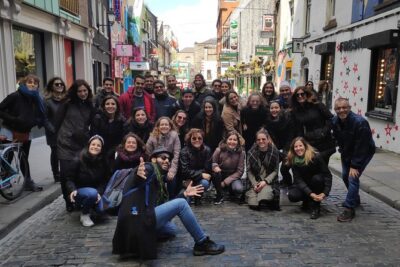
The maximum group size is 30. That is manageable, but it is not intimate. At busy moments, you may need to move closer to hear, especially beside a road or near the River Liffey. One guide has been especially considerate of a participant using a walker, but the tour remains a walking activity with several outdoor stops.
The advertised duration is about two hours. Allow extra time in your day. One outing took close to three hours, and that can happen when the group asks questions, the guide adds stories, or the route includes more sites.
Is $27.81 fair for this Dublin walk?
At about $27.81 per person, the price is reasonable for a two-hour guided walk, especially given the amount of historical explanation. You are paying for a professional guide and an organized route, not for entry to a museum or attraction.
The value is strongest if you want to understand the political background behind Dublin’s landmarks. If you only want a quick look at the GPO and a few famous statues, you can see those places on your own. You will not get the same structure, connections, or chance to ask questions.
The tour also saves you from trying to arrange the route yourself. City Hall, Dublin Castle, the Four Courts, O’Connell Monument, the Larkin statue, the GPO, and possibly Moore Street cover a lot of ground. The guide explains why each place matters, which is the part most independent walks lack.
Alcoholic drinks are available for purchase at the International Bar, but they are not included. Keep that separate from the tour cost when planning your morning or afternoon.
Who should book the 1916 Rebellion Walking Tour?
I recommend this tour most strongly to history fans, first-time visitors who want political context, and anyone curious about how Irish independence developed. You do not need prior knowledge, but you should enjoy listening to a sustained explanation rather than expecting a light sightseeing stroll.
It also suits repeat visitors. The route changes, and a different guide may emphasize different details. One person has taken the walk three times and continued to learn new material, which makes sense given the range of subjects covered.
Families can attend, but children must be accompanied by an adult. Most people can take part, and the tour is near public transport. Since much of it happens outdoors, bring sensible clothing for Dublin weather. The tour requires good weather and may be rescheduled or refunded if conditions force cancellation.
Free cancellation is available up to 24 hours before the start time. If you cancel later, you should not expect a refund.
Should you book it?
Book this walk if you want Dublin’s monuments to make sense. The strongest parts are the opening context, the detailed GPO discussion, the visible marks of fighting, and the guides’ ability to mix facts with songs, humor, and human stories.
Think twice if you need a tightly timed two-hour activity, dislike standing outdoors, or prefer a small private group. The group can reach 30, and the walk may run long.
For most visitors interested in Ireland’s political past, the price is fair and the route is well chosen. I would schedule it early in your Dublin stay, then revisit the GPO or Moore Street on your own after the story has had time to settle.
FAQ
Where does the 1916 Rebellion Walking Tour start?
The tour starts at the International Bar, 23 Wicklow Street, Dublin, D02 VH59, Ireland.
Where does the tour finish?
The activity ends back at the meeting point.
How long does the tour last?
The stated duration is approximately two hours. You should allow extra time because the walk can run longer, especially with questions, additional stories, or a larger group.
What language is the tour offered in?
The tour is offered in English.
What sites does the walk visit?
Typical stops include City Hall, Dublin Castle, the Four Courts, the O’Connell Monument, the Jim Larkin statue, the GPO, Moore Street, and the Bank of Ireland, also known as the Old Parliament. The route can vary.
Is the GPO included?
Yes. The GPO is a key stop, with about 30 minutes usually devoted to its role as headquarters of the 1916 revolutionaries and the place where Pádraig Pearse read the Proclamation.
Are drinks included in the price?
No. Alcoholic drinks are available for purchase, but they are not included.
How many people can join the tour?
The maximum group size is 30 people.
Can I cancel for a refund?
Yes, if you cancel at least 24 hours before the experience begins. Cancellations made less than 24 hours before the start time are not refunded. If poor weather cancels the tour, you will be offered another date or a full refund.
Just added around Dublin
- Women Of Ireland: Trailblazers & Pioneers★ 5.0 · 4 reviews
- Whiskey Tasting Tour of Dublin★ 5.0 · 117 reviews
- Premium Irish Whiskey Tasting Hosted by Local Dublin Expert★ 5.0 · 77 reviews
- Historical Walking Tour of Dublin★ 5.0 · 50 reviews
- Dublin (Dun Laoghaire) Top-Rated Coastal Walking Tour★ 5.0 · 80 reviews
- Semi-Private (8people max) 2.5 Hr Dublin Walking Tour★ 5.0 · 69 reviews
- Private Ultimate Day in Dublin (Walking Tour)★ 5.0 · 30 reviews
- DayTripper Dublin: A Guided City Walking Tour★ 5.0 · 90 reviews
Walking Tours, compared.
Dublin Highlights and Hidden Gems Guided Walking Tour
Our verdict on it →
90 Minute Dublin Walking tour and Sightseeing tips
Our verdict on it →
Dublin Traditional Irish 3 Course Meal Walking Tour with Local
Our verdict on it →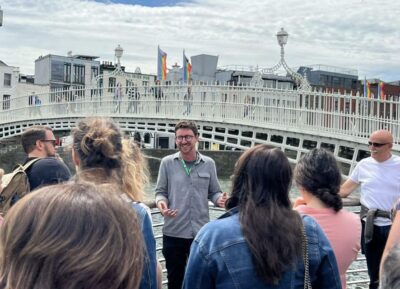
Browse the lists this tour appears in