
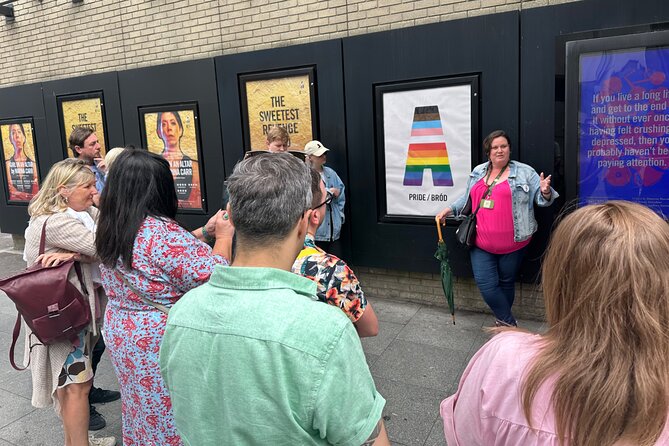
Reviewed · HISTORICAL TOURS
Dublin LGBTQ Pride Historical and Cultural Walking Tour
Dublin’s LGBTQ+ story is written into places you might otherwise pass without a second thought. This two-hour city walk links Temple Bar, the GPO, the Abbey Theatre, Trinity College, The George, and Dublin Castle with the people and events that shaped queer life in Ireland.
I like the way the route connects national history with personal stories, including LGBTQ+ figures tied to the 1916 Easter Rising, artists, activists, and a trans campaigner. I also like the price: at about $29.02, you get a focused history lesson while seeing much of central Dublin on foot. The main consideration is pace. You cover many stops in two hours, and the group can be as large as 100 people, even though the experience is often presented as a smaller group walk.
- Queer history at famous landmarks: The GPO, Abbey Theatre, Trinity College, and Dublin Castle take on new meaning.
- Two named guides: Helena and Deidre, also written as Deidree in one account, are praised for energy and clear storytelling.
- Temple Bar is more than pubs: You visit sites tied to Ireland’s first LGBTQ+ headquarters and Dublin’s changing queer community.
- A serious look at activism: The tour covers the first Irish Pride parade and the struggle for LGBTQ+ rights.
- Central route with no admission fees: The walk uses public streets and landmarks, though Trinity College entry is not included.
- Easy booking terms: You receive confirmation at booking and can cancel for a full refund up to 24 hours before the start.
Why this Dublin walk is different
Most Dublin walking tours give you the standard roll call: Vikings, Georgian doors, the Easter Rising, literary greats, and a pub or two. This tour takes familiar places and asks a different question: where are the queer people in those stories?
That change in viewpoint is the real value. At the GPO, you do not simply hear about the 1916 rebellion. You learn about gay figures connected with that week and how their lives have been remembered. At the Abbey Theatre, Ireland’s national stage becomes a doorway into the life of a modern gay Irish icon.
The route also gives you a better sense of how rights are won. It is not only a parade of famous names. You hear about hardship, public ridicule, activism, community spaces, and the people who kept going when progress was far from certain.
Guides Helena and Deidre are singled out for their energy and commitment. Their approach appears to combine LGBTQ+ history with women’s rights and wider Irish history, which helps the walk make sense even if you are new to the subject.
Starting in Temple Bar and crossing the Liffey
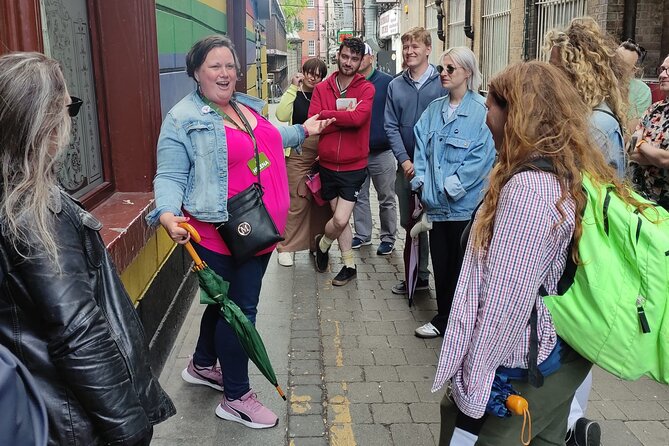
Meet at 3 Crown Alley in Temple Bar, Dublin 2. This is a practical starting point because Temple Bar is central, easy to reach by public transport, and familiar to nearly anyone spending time in Dublin.
The first stop takes about 10 minutes. From there, the group crosses Dublin’s most photographed bridge as the tour moves into the wider city center. The exact bridge is not named in the tour details, so you should treat this as a scenic transition rather than a separate attraction with a long visit.
Temple Bar can be noisy and crowded, especially at busy times. That may make it harder to hear a guide, particularly if the group is large. Stay close, listen carefully, and arrive a few minutes early so you are not trying to locate the group in the middle of the district.
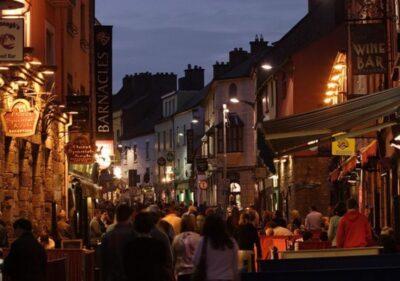
The tour later returns to Temple Bar, so you get more than a quick opening glance. Its pubs and old lanes become part of a story about community, nightlife, meeting places, and the changing shape of queer Dublin.
More History Tours in Dublin
- Dublin Historical Centre Food Tour with 8 Food Tastings & Drinks
★ 5.0 · 1,718 reviews - 2-Hour Historical Walking Tour from Dublin
★ 5.0 · 875 reviews - Historical 2-Hour Guided Walking Tour of Dublin
★ 4.7 · 865 reviews
The GPO and LGBTQ+ figures of 1916
The General Post Office is one of Dublin’s most important historic buildings. It was the central stage of the Easter Rising, and its broad political meaning is familiar to anyone who has studied Irish independence.
This tour adds a less often told layer. You learn about gay figures connected with the events of that week and consider how they have been remembered. That is a useful correction to the usual version of national history, which can leave LGBTQ+ lives at the edge of the picture.
The stop lasts about 10 minutes, and no admission ticket is included. The experience does not present itself as a full visit to the GPO Museum. Instead, the building works as an outdoor setting for a focused talk.
That distinction matters. If you want to explore the museum galleries, you will need to arrange that separately. If you mainly want the historical context and the queer stories connected to the building, the short stop keeps the whole walk moving.
The Abbey Theatre and a modern Irish icon
Next comes the Abbey Theatre, Ireland’s national stage. Theatre has long been a place where questions about identity, society, gender, and power can be brought into public view, so it is a natural stop for this walk.
Here, the guide introduces one of Dublin’s contemporary gay icons and explains that person’s role in shaping modern Ireland. The details supplied for the tour do not name the icon, which keeps the focus on what you will learn rather than giving away the story in advance.
You spend around 10 minutes at the theatre. That is enough time for a clear introduction, but not enough for a performance or an inside tour. Think of the Abbey as one chapter in a moving conversation, not a full theatre visit.
I like this part because it links culture and political change. A person’s influence is not limited to legislation or public demonstrations. Theatre, public identity, and the courage to be visible can also change how a country sees itself.
Liberty Hall and the first Irish Pride parade
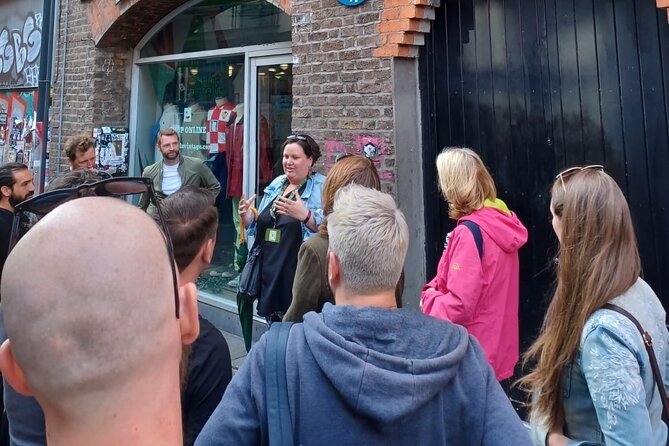
Liberty Hall brings the tour into a more difficult part of the story. You hear about the painful circumstances around Ireland’s first gay Pride parade and the challenges faced by the community at that time.
The stop also introduces one of Ireland’s notable trans activists. This gives the walk a wider reach than a history focused only on gay men and lesbian women. The LGBTQ+ movement has always included people with different experiences, and this section recognizes that.
The subject matter can be serious. The tour deals with discrimination, fear, and the cost of being publicly identified as LGBTQ+. It is not simply a cheerful sightseeing walk, though the guides’ energy helps keep the experience approachable.
Liberty Hall takes about 10 minutes. That may feel brief for a subject with so much weight, but the compact format allows the route to cover more of central Dublin. If you want a full academic treatment of Irish Pride or trans history, you will need other sources as well.
More Walking Tours in Dublin
- Dublin Highlights and Hidden Gems Guided Walking Tour
★ 5.0 · 6,020 reviews - Dublin: Highlights and Hidden Gems Walking Tour
★ 4.9 · 2,140 reviews - 1916 Rebellion Walking Tour
★ 5.0 · 1,605 reviews - 90 Minute Dublin Walking tour and Sightseeing tips
★ 5.0 · 916 reviews
Trinity College and the people behind the old arch
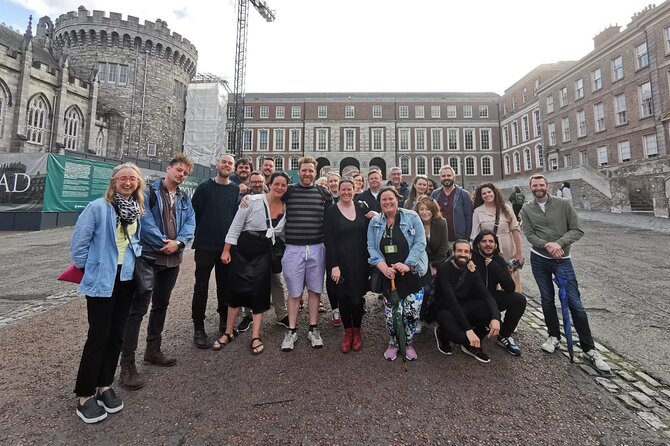
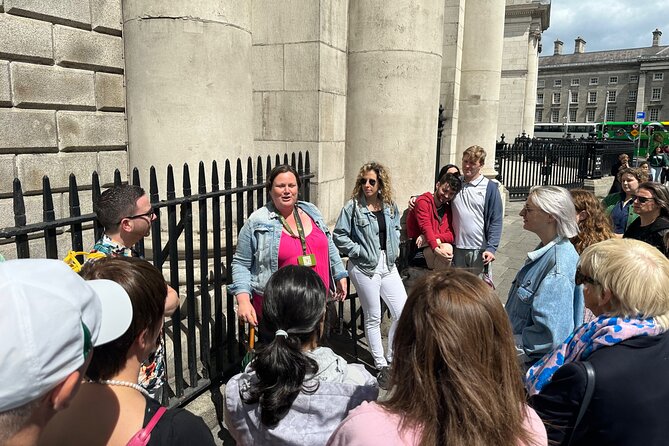
Trinity College Dublin is the oldest and best-known college in Ireland. Its famous entrance and college green provide another familiar scene, but the tour shifts attention away from architecture and toward LGBTQ+ alumni.
You learn about queer people who passed beneath the college’s old arch and consider the wider role of the college green area. This is one of the moments when the tour makes a standard Dublin landmark feel less predictable.
The stop lasts about 10 minutes. Admission is not included, so you should not expect entry to Trinity’s buildings or attractions as part of the walk. The tour uses the college as a setting for stories and context.
That is useful for a first visit because Trinity is already likely to be on your list. You see it with a specific purpose, then can decide later if you want to return for a longer visit. The short stop also means you are not paying an additional attraction fee for a tour that is designed mainly around walking and storytelling.
Meeting House Square and queer Dublin in the 1980s
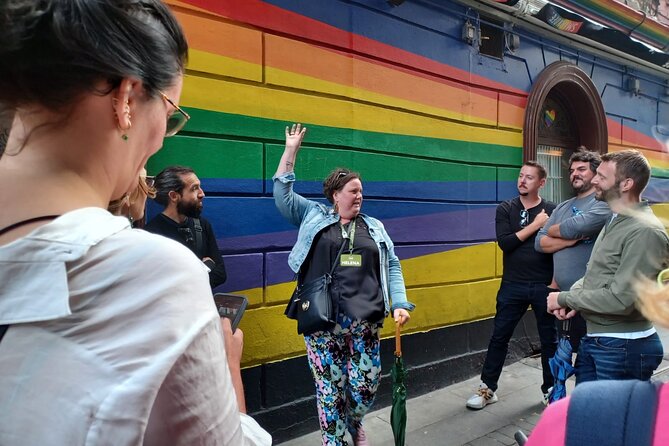
The route loops back through Temple Bar to Meeting House Square. Here, the focus shifts to Dublin in the 1980s and the people who offered hope and practical support during a hard period for the LGBTQ+ community.
The tour presents this part through community builders, thinkers, and change makers. That matters because queer history is not only a sequence of laws and protests. It is also made in cafés, meeting rooms, cinemas, discos, and ordinary places where people can find one another.
The square is part of the route rather than an attraction with an included ticket. You spend about 10 minutes listening before continuing through Temple Bar and across the River Liffey area connected with Anna Livia, Dublin’s famous river figure.
The guide also points out the changing face of queer Dublin in the 1980s. That phrase should not be taken to mean a full architectural study of the district. Instead, expect an account of how places and social spaces changed as the community became more visible and organized.
Temple Bar’s first LGBTQ+ headquarters
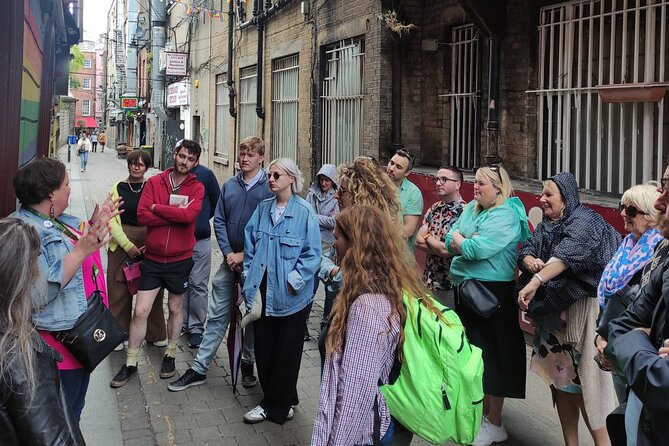
The return to Temple Bar brings one of the tour’s most distinctive stops. You hear about Ireland’s first bona fide gay headquarters, a place that included a café, disco, cinema, and other facilities.
This is where the tour moves beyond well-known political sites. A community headquarters tells you what people needed in daily life: a place to meet, watch a film, dance, find information, and feel less alone.
The stop lasts about 10 minutes and carries no separate admission charge. The building’s role is more important than its appearance. You may walk past without noticing anything special, which is exactly why a guide adds value here.
For me, this is one of the strongest parts of the route. A national monument tells you what a country chose to commemorate. A community space tells you how people actually lived, organized, and found one another.
The George, Dublin’s long-running gay bar
The George is described as Dublin’s oldest operating gay bar and a cultural institution. The tour explains the place it still holds at the center of the city’s LGBTQ+ community.
You should expect to learn about the bar’s significance, not a guaranteed stop for drinks or entry into a private event. The tour details do not promise a drink, reserved seating, or an inside visit. The point is to understand The George as a living part of Dublin’s queer story.
This stop also gives the history a present-day connection. Earlier parts of the walk focus on people and events that may not be visible anymore. The George shows that community spaces remain part of the city today.
The group spends around 10 minutes here. If you plan to return later, you will have a clear reason to do so, but keep your evening plans separate from the walking tour unless the guide gives you different instructions on the day.
Finishing inside Dublin Castle
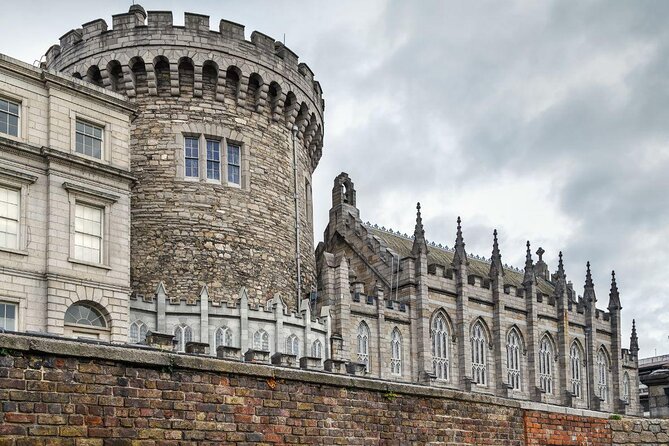
The walk finishes in the upper courtyard of Dublin Castle, surrounded by centuries of Irish history and 18th-century architecture. The end point is at the center of Dublin, which makes it useful for continuing to dinner, sightseeing, or public transport.
Dublin Castle gives the final section a grand setting. The route begins in Temple Bar and ends among one of the capital’s most important historic buildings, covering a good portion of central Dublin along the way.
The end point is not simply a convenient place to stop. It puts the LGBTQ+ story beside the official story of Ireland, government, power, and national memory. That contrast is fitting for a tour built around people who were often left out of the public record.
No admission fee is included for the castle. The supplied details describe the finishing location, not a castle interior tour, so plan on receiving the historical talk as part of the walk rather than touring every room.
What $29.02 buys you
At about $29.02 per person, the price is fair for a two-hour guided walk in central Dublin. You are paying for a specialized subject, a planned route, and a guide who can connect scattered sites into one clear story.
The value is strongest if you already intend to visit Temple Bar, the GPO, Trinity College, the Abbey Theatre, and Dublin Castle. Instead of seeing them as separate stops, you get a single theme that ties them together.
The price does not include attraction admissions, drinks, or meals. That keeps the cost simple, but it also means you should budget separately if you want to enter Trinity College attractions, the GPO Museum, or Dublin Castle interiors.
The average booking point is 25 days before the tour. That suggests you should reserve ahead if your Dublin dates are fixed, particularly since the tour is recommended by all of the supplied feedback and carries a five-star rating from 91 reviews. The stated maximum is 100 people, so do not assume that every departure will be intimate.
Who will get the most from this tour
This walk suits you best if you want Irish history told through LGBTQ+ lives rather than through a standard national story. It is also a strong choice if you are visiting Dublin for the first time and want to see several central landmarks at the same time.
You do not need to identify as LGBTQ+ to find the subject worthwhile. The route connects queer history with the Easter Rising, women’s rights, theatre, public life, and modern Ireland. It can help any curious visitor understand the city with greater care.
The walk may be less suitable if you want extensive time inside museums, a relaxed pace, or a highly private experience. Each stop is short, and the group may be large. You should also be comfortable with moderate physical activity and a two-hour city walk.
Service animals are allowed, and the starting point is near public transport. The ticket is mobile, and confirmation arrives when you book. For cancellations, you can receive a full refund if you cancel at least 24 hours before the local start time. Changes or cancellations inside that window are not accepted.
Should you book this LGBTQ+ history walk?
Book it if you want Dublin’s famous sights to carry more than the usual stories. The strongest reason to go is the way the guide connects national events with people who have often been forgotten, from 1916 figures to activists, artists, and community builders.
I would especially recommend it early in your Dublin stay. The route introduces central landmarks, points you toward queer spaces such as The George, and gives you useful context for exploring the city on your own afterward.
Skip it if you are looking for a museum-heavy tour, a private walk, or guaranteed small-group attention. For everyone else, $29.02 is a sensible price for a focused two-hour introduction to queer Dublin, provided you are ready to walk, listen, and take in some serious history along with the lively city streets.
FAQ
How long does the Dublin LGBTQ+ Pride Historical and Cultural Walking Tour last?
The tour lasts approximately two hours.
Where does the tour begin?
The meeting point is 3 Crown Alley in Temple Bar, Dublin, D02 CX67, Ireland.
Where does the tour finish?
The tour finishes in the upper courtyard of historic Dublin Castle.
Is admission to Trinity College included?
No. Admission to Trinity College is not included in the tour.
What language is the tour offered in?
The tour is offered in English.
Can I cancel for a full refund?
Yes. You can cancel at least 24 hours before the experience starts for a full refund. Cancellations or changes made less than 24 hours before the start time are not accepted.
Just added around Dublin
- Women Of Ireland: Trailblazers & Pioneers★ 5.0 · 4 reviews
- Whiskey Tasting Tour of Dublin★ 5.0 · 117 reviews
- Premium Irish Whiskey Tasting Hosted by Local Dublin Expert★ 5.0 · 77 reviews
- Historical Walking Tour of Dublin★ 5.0 · 50 reviews
- Dublin (Dun Laoghaire) Top-Rated Coastal Walking Tour★ 5.0 · 80 reviews
- Semi-Private (8people max) 2.5 Hr Dublin Walking Tour★ 5.0 · 69 reviews
- Private Ultimate Day in Dublin (Walking Tour)★ 5.0 · 30 reviews
- DayTripper Dublin: A Guided City Walking Tour★ 5.0 · 90 reviews
Historical Tours, compared.

Dublin Historical Centre Food Tour with 8 Food Tastings & Drinks
Our verdict on it →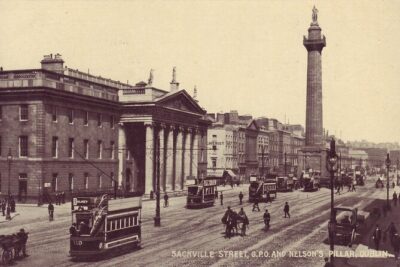

Dublin to Cork, Blarney Castle & Cóbh Heritage Centre by train
Our verdict on it →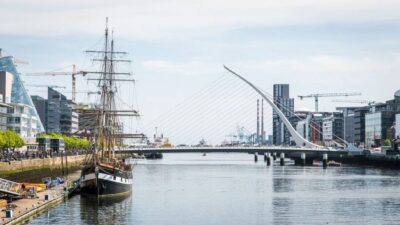
Jeanie Johnston Tall Ship Irish Famine History Tour
Our verdict on it →

Deliciously Dublin: The Artisan Donut Walking & History Tour
Our verdict on it →
Browse the lists this tour appears in