
Reviewed · WALKING TOURS
Small Group Bucket List Sights Walking Tour with a Local Guide
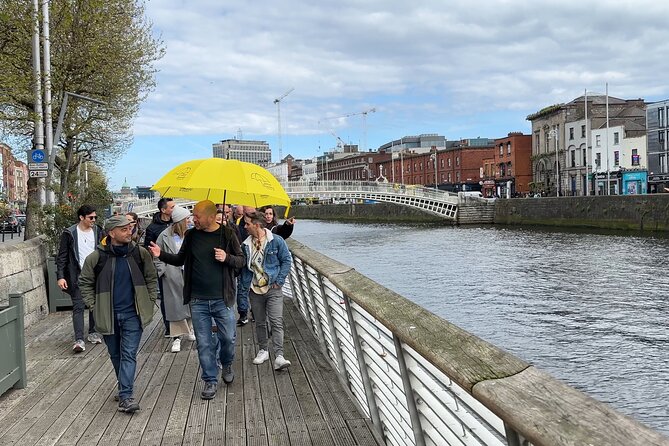
Dublin’s story unfolds quickly on this walking route, from Viking beginnings at Christ Church to the grand Georgian buildings around Trinity College. In about two hours, you cross the Liffey, pass the city’s best-known sights, and get a useful sense of how central Dublin fits together.
I like the wide range of stops and the way the guides connect buildings to Irish political and social history. I also like the practical orientation: guides such as Peter, Patrick, Rob, and Martin have offered suggestions for museums, walks, and things to do after the tour. The main drawback is simple: you see the major interiors from outside, since admission tickets are not included.
Key points at a glance
- Twelve central Dublin sights: The route covers Christ Church Cathedral, St. Patrick’s Cathedral, Dublin Castle, Temple Bar, the Liffey bridges, College Green, and Trinity College.
- A useful first-day orientation: You finish outside Trinity College, ready to continue with the Book of Kells or explore nearby streets on your own.
- Strong guide-led storytelling: Peter is especially noted for clear explanations, questions, and practical suggestions, while Patrick, Rob, and Martin have also led tours.
- A two-hour walking format: Each listed stop lasts about 10 minutes, so you get broad coverage rather than long visits inside individual sites.
- Good value at $20.52: The price is low for a guided introduction, but you’ll need a separate budget for cathedral, castle, or Book of Kells admission.
- A capped group of up to 25: It is more personal than a large coach tour, though the maximum group size is not intimate.
Why this route works for a first look at Dublin
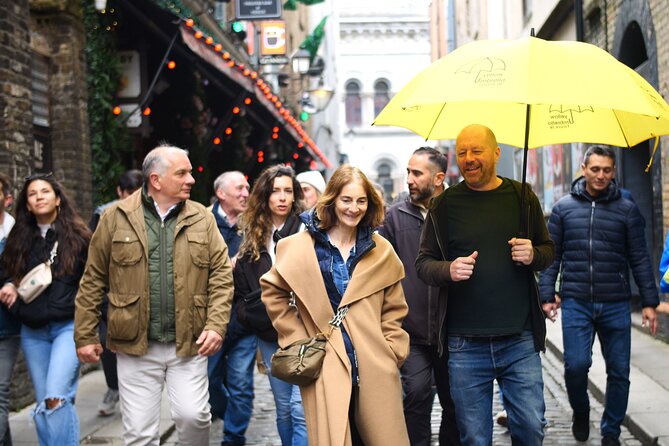
This is a city-orientation walk rather than a building-by-building tour. You move through the heart of old Dublin, stopping often while your guide explains what you are seeing and how it fits into the city’s past.
That format suits you if you have only a short stay or want help finding your bearings on the first morning. Several guides have been praised for answering questions and suggesting what to do later, which gives the walk value beyond its scheduled two hours.
The route also has a sensible shape. It begins on the south side of the Liffey at Wood Quay, moves through the cathedral district and Dublin Castle, crosses to the north side at Millennium Bridge, then returns over Ha’penny Bridge and finishes at College Green. You are not simply ticking off isolated monuments. You are watching the city change from medieval lanes to civic buildings, pub streets, riverfront views, and the formal setting of Trinity College.
At $20.52 per person, the tour is priced as an affordable introduction. I think that is fair if you want a guide to explain the city while you walk. It is less of a bargain if your main goal is entering the cathedrals or seeing the Book of Kells, since those tickets cost extra.
More Walking Tours in Dublin
- Dublin Highlights and Hidden Gems Guided Walking Tour
★ 5.0 · 6,020 reviews - Dublin: Highlights and Hidden Gems Walking Tour
★ 4.9 · 2,140 reviews - 1916 Rebellion Walking Tour
★ 5.0 · 1,605 reviews
Christ Church and St. Patrick’s: Dublin’s cathedral story
The walk opens at Christ Church Cathedral, one of the strongest stops on the route. The cathedral began as a Viking wooden church before the Normans rebuilt it in stone. The guide also explains how 19th-century restoration was supported by whiskey money, a detail that links Dublin’s religious buildings to the fortunes made in local industry.
You get about 10 minutes here, enough to study the exterior and hear the main story. If you want to see the interior, you must pay separately, so consider returning later if the cathedral is a priority.
St. Patrick’s Cathedral follows. It is named for Ireland’s patron saint, associated with the famous story of driving snakes from the island. The cathedral was heavily restored in the 1860s by Sir Benjamin Lee Guinness, a reminder that the Guinness family shaped Dublin through more than beer.
These two cathedral stops give you a quick comparison. Christ Church brings Viking and Norman beginnings into view, while St. Patrick’s connects religious tradition with 19th-century wealth and restoration. Ten minutes at each site will not satisfy a serious architecture fan, but it helps you decide which one deserves a longer visit.
Dubh Linn Gardens and Dublin Castle
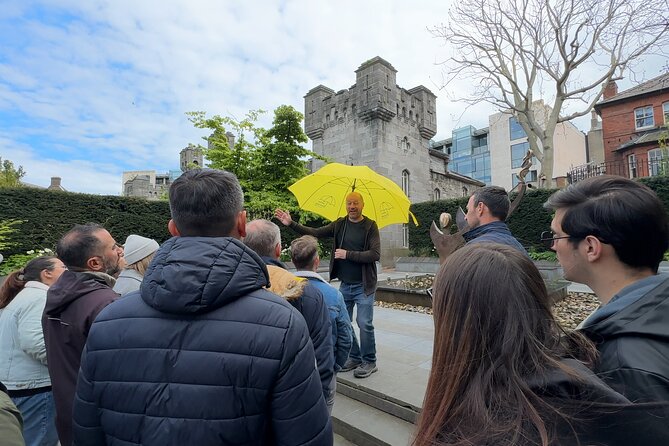
Dubh Linn Gardens offers a quieter pause. The garden is home to the Chester Beatty Library and is linked to the Viking moorings that gave Dublin its name and early importance. The tour description places the Viking longboats here in the 9th century, so this stop gives your guide a natural point for explaining the city’s earliest development.
Admission to the garden is free. That matters because you can return later without paying for an entry ticket, although the Chester Beatty Library is a separate attraction and is not part of the walking tour.
Next comes Dublin Castle, a compact lesson in the city’s political past. For 700 years, it served as the centre of British government in Ireland. Its architecture reflects several periods, including medieval, Georgian, Gothic, and modern work.
The guide’s role is especially useful here. A quick look at the castle cannot reveal all those layers on its own. You need someone to point out the changes and explain why such different styles appear in one complex.
The castle is another stop where entry is not included. I would treat the walk as a preview. If you are interested in government, architecture, or Irish independence, save time later for an inside visit.
City Hall and the meaning of the Irish flag
At City Hall, outside the castle gates, the guide explains the meaning behind Ireland’s national flag. The green, white, and orange colors are presented as a symbol of peace between Catholic and Protestant communities, and between North and South.
This is a brief stop, but it adds political context to the buildings around you. Instead of hearing only dates and architectural labels, you get an explanation of how national identity is expressed in public space.
City Hall itself sits beside one of Dublin’s most important historic complexes, so the location helps tie the earlier castle discussion to the development of modern Ireland. The stop is free and mainly involves listening outside.
Same part of the country, a completely different day out:
- Dublin: Guinness Storehouse Entry Ticket
★ 4.6 · 16,863 reviews - Irish Rock ‘N’ Roll Museum Experience Dublin
★ 5.0 · 6,112 reviews - Dublin: Jameson Whiskey Distillery Tour with Tastings
★ 4.7 · 4,859 reviews - Dublin Jameson Distillery Bow St. Tour and Tasting 45 mins
★ 5.0 · 4,690 reviews
Temple Bar, without reducing Dublin to nightlife
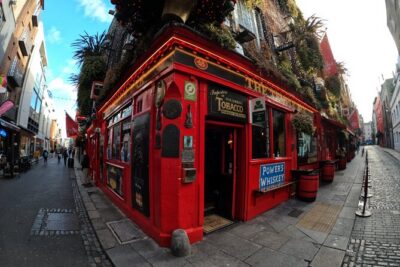
Temple Bar is one of Dublin’s oldest areas and is now famous for pubs and nightlife. The guide explains how the area was laid out during the Tudor conquest of Ireland, giving you a historical layer beneath the modern entertainment district.
You should know what this stop is and is not. The tour does not turn into a pub crawl, and it does not include drinks. Instead, you get a short account of the district before you continue through the city.
That is useful because Temple Bar can easily become Dublin’s entire image if you only see the pub signs and crowds. A guide can place it in the older street plan and show you that the area is more than an evening stop.
Crossing the Liffey at Millennium Bridge
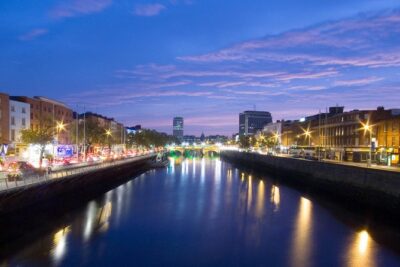
Millennium Bridge provides one of the route’s best chances to see Dublin as a whole. Crossing from south to north, you look along the River Liffey and hear a broad story that runs from the Celtic settlement in the east to the modern Silicon Docks in the west.
The bridge itself is free to cross, but it adds movement to the tour. You are not standing in front of another monument. You are changing sides of the city and gaining a view that helps connect Dublin’s old centre with its newer districts.
This is also a good place to ask questions. The guides are encouraged to make the walk conversational, and the river gives you an easy subject if you want to understand how Dublin has grown beyond its medieval core.
Ha’penny Bridge and Merchant’s Arch
The route returns south across Ha’penny Bridge, one of Dublin’s most recognizable crossings. It was originally named for the Duke of Wellington, and the guide also explains why the bridge no longer shakes as people walk across it, with Harland & Wolff involved in its later history.
You get a brief bridge story and a memorable view of the river. Since the bridge is narrow and popular, the group may need to keep moving, but that is part of the point. This is a working piece of the city as well as a landmark.
Nearby Merchant’s Arch introduces another change in mood. Dublin’s contrasts appear along Crown Alley, with Merchant’s Arch at one end and the modernist Stephenson Tower at the other. The guide uses this stretch to show how old and new architecture sit close together in central Dublin.
The stop is free to experience from the street. It may be brief, but it gives you a useful way to read Dublin’s built environment instead of seeing each building as an unrelated sight.
College Green and the Molly Malone stop
College Green brings you into one of the city’s most impressive civic spaces. Banks and former parliamentary buildings line the area, which once served as a centre of government and finance for a city that saw itself as the second city of the empire.
This is a good place for architectural context. The guide can explain how power and money shaped the buildings, while you look at the formal facades around the square.
The Molly Malone statue follows, offering a lighter stop after the political material. No first visit to Dublin feels complete without greeting this famous fictional fish seller, though the tour gives you only a short moment here.
The statue is not a major historical site in the same way as Dublin Castle or Trinity College. Its value is cultural and playful. It gives the route a familiar Dublin character before the final stop.
Finishing at Trinity College and the Book of Kells
The walk ends outside Trinity College Dublin, an ideal place to finish. You have moved through churches, government buildings, bridges, commercial streets, and public squares, then arrive at one of the city’s most famous academic settings.
The Book of Kells exhibition is nearby, but admission is not included. That arrangement can work well. You first hear the city’s wider story, then decide if you want to spend more time at Trinity after the walk.
The endpoint is also practical. Fox House at 37 College Green is outside Trinity’s front gate, so you can continue exploring from there. Guides have offered suggestions for museums and walks, and this is the right moment to ask about your next stop.
If you have a fixed booking for the Book of Kells or another attraction, leave some time after the tour. The walk is scheduled for about two hours, but the exact finish can depend on the group and questions.
Guide style and group size
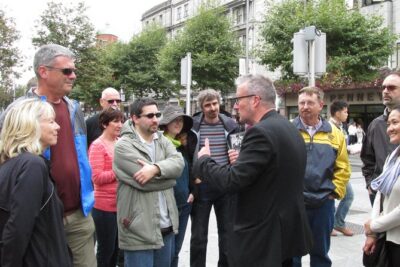
The strongest part of this experience is the guide’s ability to make a fast route feel personal. Peter is repeatedly described as friendly, clear, and willing to answer questions. He has also adjusted his presentation to include quiet places where the group can sit and listen to a subject in more detail.
Patrick has been praised for giving a concise account of Dublin and Ireland while linking each stop to political and social change. Rob has led very small departures, including one with only two participants, and kept the conversation going rather than simply reciting facts. Martin is also known for an energetic approach.
You cannot choose a particular guide from the information provided, so expect the individual style to vary. The common benefit is local interpretation, not a recorded script.
The group limit is 25 people. That is small compared with a coach excursion, but it can still feel busy at narrow streets or popular bridges. If you value a quiet, private experience, this may not be the right format. If you want the chance to ask questions without paying for a private guide, it is a sensible middle ground.
Timing, walking demands, and what to bring
The tour starts at 10:00 a.m. at 121 R137, Wood Quay, Dublin. It finishes at Fox House, 37 College Green, Dublin 2, outside Trinity College.
The route includes city streets, bridges, and regular stops. Most people can take part, and service animals are allowed. The tour is near public transportation, which makes the start and finish practical for a day of sightseeing.
You should wear comfortable shoes and keep the morning fairly open. Twelve stops at about 10 minutes each leaves little room for long interior visits. Bring questions, especially if you want help choosing between Dublin’s museums, cathedrals, and other attractions later in your stay.
The tour is offered in English and uses a mobile ticket. Confirmation arrives when you book. Free cancellation is available until 24 hours before the start time. Within 24 hours, refunds and changes are not accepted.
Who should book this Dublin walk?
I would recommend it most strongly to first-time visitors, short-break visitors, and anyone who wants a clear introduction before exploring alone. It is also useful for you if dates and names blur together when you sightsee without context.
Families and mixed-age groups may like the frequent changes of scene. The route has churches, gardens, bridges, statues, and public buildings, so you are rarely focused on one kind of sight for long.
History fans should see the walk as an introduction rather than a full tour of Dublin’s interiors. You will not enter Christ Church, St. Patrick’s Cathedral, Dublin Castle, or the Book of Kells exhibition with the basic tour price.
Should you book it?
Book this walking tour if you want broad coverage, local explanation, and good value in your first two hours in Dublin. The price is modest, the route covers the central sights, and guides such as Peter, Patrick, Rob, and Martin add practical advice that can shape the rest of your visit.
Skip it if you prefer to spend two hours inside one cathedral or museum, or if you want a private tour with a slower pace. For most first visits, though, this is a useful way to connect Dublin’s Viking beginnings, religious buildings, political past, river crossings, pub district, and Trinity College before choosing where to spend more time.
FAQ
How long is the Dublin walking tour?
The tour lasts approximately two hours.
Where does the tour start?
It starts at 10:00 a.m. at 121 R137, Wood Quay, Dublin, Ireland.
Where does the tour finish?
It finishes outside the front gate of Trinity College at Fox House, 37 College Green, Dublin 2.
Are admission tickets included?
No. Admission is not included for Christ Church Cathedral, St. Patrick’s Cathedral, Dublin Castle, or the Book of Kells exhibition. Dubh Linn Gardens, City Hall, Temple Bar, College Green, and several outdoor stops are listed as free.
How large is the group?
The tour has a maximum of 25 participants.
Can I cancel for a full refund?
Yes. You can cancel at least 24 hours before the experience start time for a full refund. Cancellations or changes made less than 24 hours before the start time are not accepted.
Just added around Dublin
- Trek the Tombs and Trails in the Dublin Mountains★ 5.0 · 14 reviews
- Turtle Bunbury’s Dublin: A Self-Guided Audio Tour from a Celebrated Author★ 5.0 · 3 reviews
- Taste traditional Irish food in the heart of Dublin★ 5.0 · 24 reviews
- Private Tour of Dublin Museums (Walking Tour)★ 5.0 · 13 reviews
- Dublin 6 Whiskey Tasting & 3 Food Pairing Walking Tour with Local★ 5.0 · 42 reviews
- From Dublin: Private Tour to Hill of Tara, Trim Castle and more★ 5.0 · 11 reviews
- Merry Ploughboys Irish Night Dublin Admission Ticket★ 4.5 · 59 reviews
- The Perfect Pint Pub Tour★ 5.0 · 144 reviews
Walking Tours, compared.
Dublin Highlights and Hidden Gems Guided Walking Tour
Our verdict on it →
90 Minute Dublin Walking tour and Sightseeing tips
Our verdict on it →

Dublin Traditional Irish 3 Course Meal Walking Tour with Local
Our verdict on it →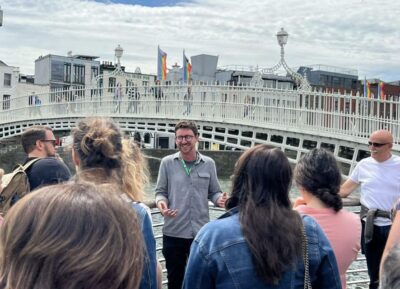
Browse the lists this tour appears in